THE MEN ON THE EDGE-#12
October 12, 2026
“Listen to me, O house of Jacob, all the remnant of the house of Israel, who have been borne by me before your birth, carried from the womb; even to your old age I am he, and to gray hairs I will carry you. I have made, and I will bear; I will carry and I will save.” (Isaiah 46:3-4)
“Be Still. There is no longer any need to comment. It was a lucky wind that blew away his halo and his cares. A lucky sea that drowned his reputation.” (From the poem When in the Soul of the Serene Disciple by Thomas Merton)
My wife and I recently returned from ten days in the Algarve in Portugal, travelling with two dear friends. We were treated to the blessing of witnessing the beauty of that region in full — touring from Tavira in the east, taking in the salt pans and islands along the southern coast, all the way west through Lagos to Sagres and Cape St. Vincent — the so-called “end of the world.”
The sights were breathtaking. Jagged cliffs and plunging drops toward a roaring ocean below, the water swaying in powerful ebbs and flows that made concentration a challenge at virtually every step. At some point you found yourself unconsciously ranking the cliffs by beauty and awe — which is a strange and wonderful problem to have.
It was during one of these walks that I came across an image I haven't been able to shake.
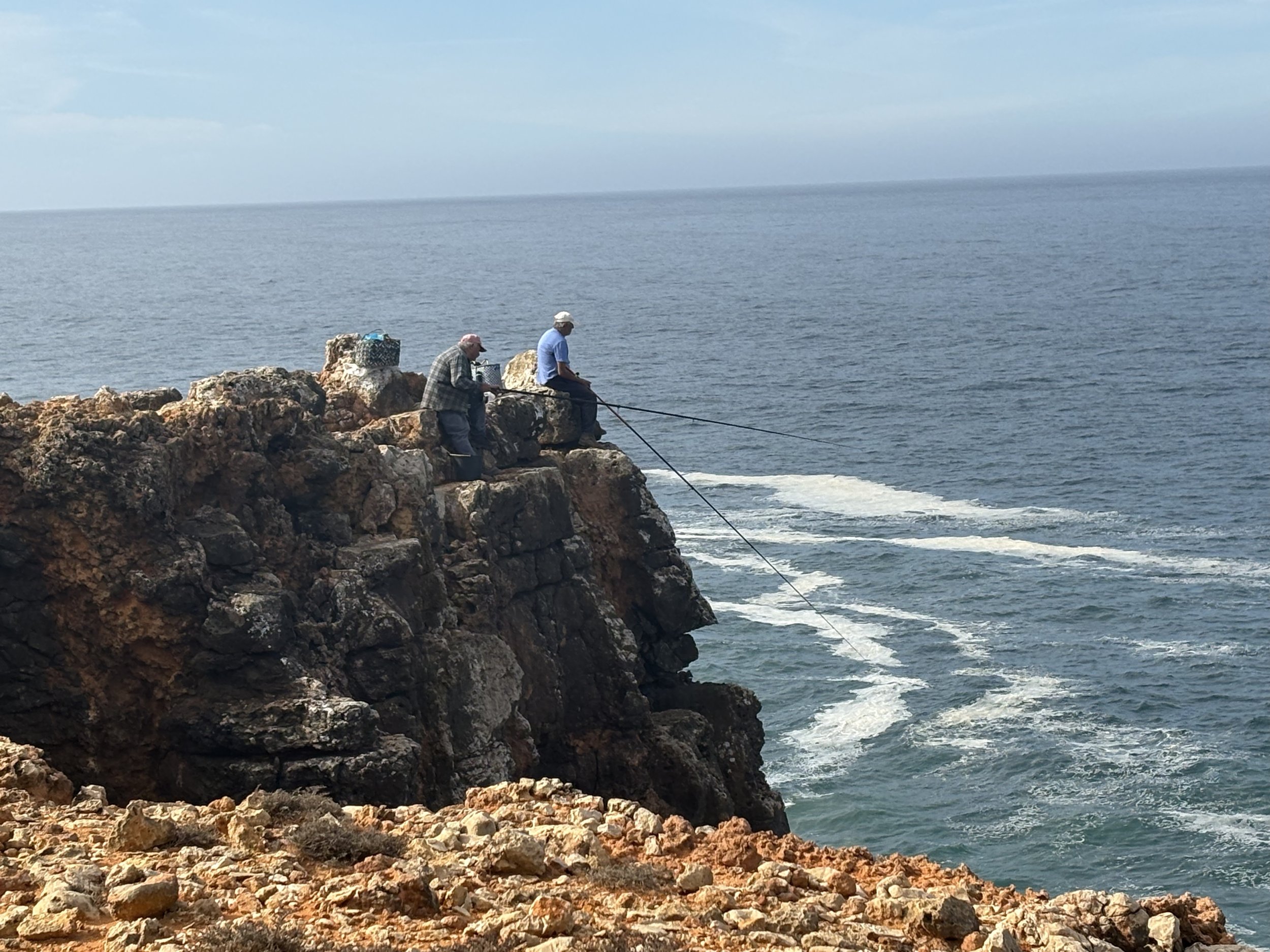
Two elderly men, fishing off a cliff face at least fifteen stories above the water. Long lines trailing down toward the ocean. My first instinct was that they had wandered somewhere they shouldn't be — no other hiker was within thirty feet of the edge. Then I noticed what looked like tackle boxes and a packed lunch set beside them and realized this was no accident. This was a planned outing. An intention.
The ocean heaved and crashed against the cliff face below them. And these two men sat there, utterly at peace, patient and still, waiting for whatever the sea might offer that day.
I couldn't stop wondering what had brought them to this place — not just physically, but in themselves. Because the hundreds of tourists streaming past, myself included, were carefully creeping as close to the edge as comfort would allow, cameras out, hearts quietly racing. And these two weren't paying us the slightest attention. They were simply content to sit right on the precipice — at ease with the peril, completely present to the moment.
How does a person arrive there?
Perhaps they started exactly as I did — as young boys, wide-eyed and shrieking at the edges, daring each other a little closer. Then life pulled them inland for decades. Work, family, the accumulated weight of responsibility. Perhaps they returned occasionally with their own children, watching the same wonder play out in a new generation. Perhaps they witnessed what the seasons could bring to those same cliffs — not the postcard version but the rage and fury of an Atlantic winter, waves swallowing the rock faces entirely.
And perhaps, as the years passed, the awe gave way to something quieter. A deeper familiarity. The kind that no longer needs to look around in amazement because it has already internalized the whole landscape — every line, every water mark, every shift in the light. By now they could likely trace that entire shoreline with their eyes closed.
I found myself thinking — isn't this what any truly valued relationship looks like at its best? Not just in friendship, but in faith. The idea that God might long for us to arrive at that same kind of settled comfort — having traversed all the peaks and valleys of our own particular journey, no longer anxious at the edges, simply present to what is and what will be.
I don't know if I'm there. I'm not sure I'm anywhere close. But I carried that image with me for the rest of the week — and found myself looking at what was in front of me, and what I had left behind, with a little more appreciation than I'd had before.